
TL;DR
Open a free Amazon Business account
Business pricing, bulk buying and tax-exempt orders.
Create a free accountAs an affiliate, we earn on qualifying purchases.
Reducing noise isn’t just about acoustic foam. Moving your rig into another room, especially a closet, can cut noise dramatically. Proper ventilation is key to prevent overheating when sealing a space for quiet and safety.
Ever notice how a loud machine in your room feels like a constant roar? Yet, the easiest fix isn’t always more foam or soundproof panels. The real secret? Distance and placement. Moving your rig into another room, like a closet, can make your workspace whisper-quiet—without expensive treatment. But that raises a question: how do you keep it cool, safe, and effective?
This article walks you through the clever art of acoustic dampening, smart placement, and turning a closet into a mini recording studio or AI rig hub. You’ll learn why distance beats absorption, how to ventilate a sealed space, and the best ways to treat reflections without overdoing it. Ready to turn that closet into your new best friend for noise control? Learn more about acoustic dampening and placement.
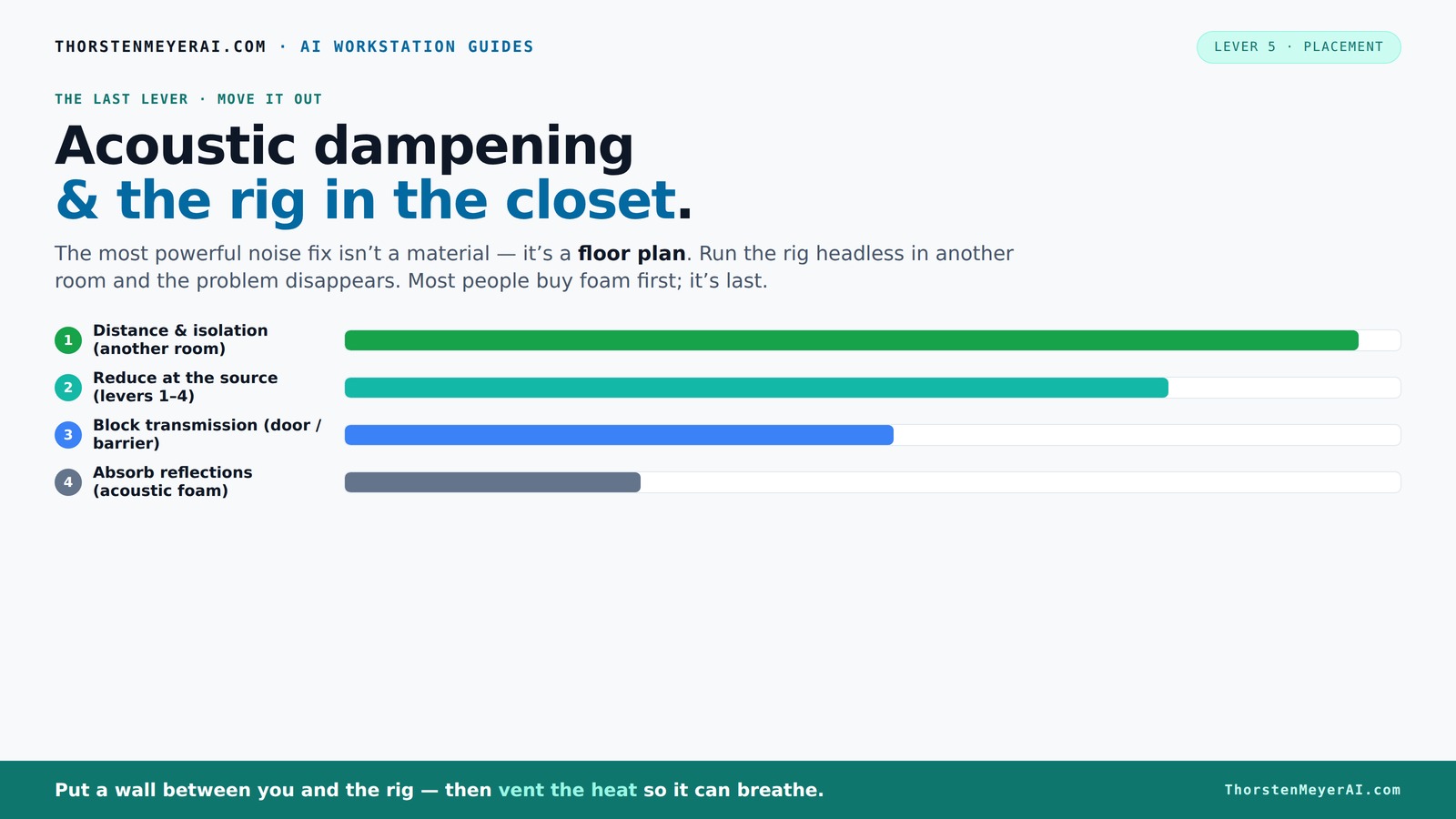
Acoustic dampening
& the rig in the closet.
The most powerful noise fix isn’t a material — it’s a floor plan. A rig you can’t hear because it’s in another room beats any amount of foam. Tap the approaches in Part 1 to see what actually works.
(another room)
(levers 1–4)
(door / barrier)
(acoustic foam)
Contain the noise, not the heat
Key Takeaways
- Distance is the most effective noise control — move your rig to another room whenever possible.
- Proper ventilation is critical to keep a sealed closet rig cool and safe during continuous operation.
- Target reflection points with acoustic panels—dont just cover walls randomly.
- Corners matter less than you think; focus on wall absorption and mic placement first.
- DIY solutions like blankets and rugs can dramatically improve sound quality on a budget.
soundproofing acoustic foam panels
As an affiliate, we earn on qualifying purchases.
As an affiliate, we earn on qualifying purchases.
Why Moving Your Rig Is the Easiest Noise Fix
Distance is the most powerful tool to cut noise. Think of it like this: a GPU rig roaring in another room is quieter than a foam-lined case sitting right next to you. When your AI setup is in a different space, you don’t have to obsess over absorption or soundproofing — the sound simply doesn’t reach you. Discover more about effective acoustic placement.
For example, I set up a high-powered AI rig in my basement closet. I SSH in, and all I hear is the faint hum of my laptop. No roar. This approach is especially perfect if you mainly work remotely or over the network. Just a solid wired connection and some ventilation, and you’re golden.
However, it’s important to understand why this works so well. Sound intensity diminishes with distance — a principle rooted in the inverse square law — meaning that doubling the distance from a noise source reduces its perceived loudness by roughly 75%. This isn’t just about comfort; it can significantly extend the lifespan of sensitive equipment by reducing noise-induced stress and vibration.
portable soundproof booth for recording
As an affiliate, we earn on qualifying purchases.
As an affiliate, we earn on qualifying purchases.
How to Ventilate a Closet Rig Without Turning It Into an Oven
Putting a hot, high-performance machine in a closet sounds perfect—until it overheats. The key is ventilation. You need airflow that moves heat out without letting sound escape. A passive vent plus an exhaust fan is the bare minimum. For serious setups, consider a purpose-built soundproof cabinet with ducted airflow and thermostatic control.
For instance, I installed a quiet, adjustable exhaust fan in my closet, ducted to a small vent on the door. It keeps the temperature stable—around 70°F—even after hours of heavy use. You avoid throttling and noise spikes while keeping your hardware safe.
Understanding the tradeoffs here is crucial. Increased airflow can introduce unwanted noise if not properly silenced, and poor ventilation can lead to overheating, which risks hardware failure. The goal is to strike a balance: ensure enough airflow to prevent heat buildup without compromising your acoustic treatment. Learn about ventilation solutions for quiet rigs.
quiet room divider for noise reduction
As an affiliate, we earn on qualifying purchases.
As an affiliate, we earn on qualifying purchases.
The Smart Placement of Panels Inside a Closet: Do Reflection Points Matter?
Acoustic dampening starts with placement. In a tiny closet, treating reflection points—like the wall behind your mic and the side walls—can drastically improve sound quality. Use the mirror trick: sit in your usual position, hold a mirror against the wall, and mark where your sound reflects. Place panels here.
For example, I installed foam panels at these points and added a ceiling diffuser. The difference? A clear, focused vocal sound with fewer echoes bouncing around. It’s more about strategic placement than covering every inch.
Why does this matter? Reflection points are where sound waves bounce and create echoes or room coloration. By treating these specific spots, you reduce early reflections that color your recordings, resulting in a cleaner, more professional sound. Find out more about reflection point treatment.
ventilation fan for sealed recording space
As an affiliate, we earn on qualifying purchases.
As an affiliate, we earn on qualifying purchases.
Do Corners Really Matter for a Closet Studio? When to Use Bass Traps
Bass traps in corners are often recommended to tame low-frequency buildup, but in a small closet, they aren’t always necessary. The key is whether you notice boominess or standing waves—if yes, go for traps. If not, focus on absorption at reflection points. Learn about bass traps and acoustic treatment.
For instance, I added small bass traps in the corners of my closet, but only after noticing low-end muddiness during recordings. For most small rooms, better mic placement and wall absorption can be more effective than heavy corner trapping. The tradeoff here involves cost and space; bass traps can be large and expensive, and in a tiny closet, they may not provide proportional benefits. Instead, investing in strategic placement of acoustic panels and choosing the right mic positioning often yields better results with less hassle.
DIY Tips for Making Your Closet Studio Sound Better on a Budget
Want better sound without breaking the bank? Focus on sealing gaps with weatherstripping, adding thick blankets and rugs, and using simple DIY panels. Heavy moving blankets hung on walls can cut reflections and leakage for less than $50. Explore more DIY acoustic tips.
For example, I draped a thick blanket over the door, lined my walls with foam panels from Amazon, and placed a rug on the floor. The result? Noticeably clearer recordings with less echo, all for under $100. It’s important to understand that these DIY treatments work by absorbing and diffusing sound waves, preventing them from bouncing around and causing echo or leakage. The key tradeoff is that while inexpensive, these solutions may not be as effective as professional treatments in highly demanding acoustic environments, but for most home setups, they strike a good balance between cost and quality.
What Microphone and Setup Work Best in a Tiny Closet?
Small spaces favor dynamic mics or shotgun condensers that reject room noise. A reflection filter adds further isolation. Position your mic close to the source, off-axis to the walls, to minimize room coloration. Experiment with angles and height.
For example, I use a shotgun mic with a reflection filter, positioned about 6 inches from my mouth, pointing slightly downward. It captures my voice clearly, with minimal room sound—perfect for a tight closet. Keep in mind, the proximity of the mic and the quality of your reflection filter can significantly influence the amount of ambient room noise captured. The better the mic and filter, the less you’ll need to rely on room treatment, but always test different positions to find the optimal setup for your space and voice.
Frequently Asked Questions
Can I make a closet completely soundproof?
While you can significantly reduce noise, complete soundproofing is tough—especially in a small closet. Sealing gaps, adding mass, and using soundproof doors help, but some leakage always remains. The goal is to make it quiet enough for your needs.How much treatment does a small closet really need?
Focus on early reflection points—walls behind your mic and in front of you—and add bass traps if low-end issues arise. Over-treating isn’t necessary; strategic placement makes a bigger difference than covering every surface.What’s the best mic for a tiny closet studio?
A dynamic mic or shotgun condenser works best because they reject room noise. Keep the mic close, off-axis, and use a reflection filter for extra isolation. Experiment with positioning to find what minimizes room sound.Do I need bass traps in a closet?
Only if you notice low-frequency muddiness or boominess. In many small rooms, better mic placement and wall absorption can handle most low-end problems without heavy corner trapping.Is it worth investing in a soundproof cabinet?
For serious noise reduction and heat dissipation, a purpose-built soundproof cabinet with ducted airflow is ideal. DIY solutions work well for lighter needs but won’t fully contain louder rigs.Conclusion
Sealing off a noisy rig in a closet isn’t just about stuffing foam everywhere. It’s about smart placement, good ventilation, and targeted treatment. When you treat your space like a mini studio—focused, strategic, and well-ventilated—you turn a simple closet into a powerful, quiet workspace.
Think of your closet as a secret weapon. With a few tweaks, you can silence the roar and focus on what really matters: your work, your sound, your creativity. Now, go pick a corner, seal it up, and make that closet work for you.
Fall Picks
fall essentials
As an affiliate, we earn on qualifying purchases.