Choosing between a thermocouple and a thermistor depends on your needs for accuracy, temperature range, and environment. Thermocouples are better if you require a wider range and durability in harsh conditions, while thermistors offer high precision in controlled settings. Rapid response or easy calibration can also influence your choice. Understanding these differences helps you select the right sensor for your application, and exploring further will give you more detailed insights.
Key Takeaways
- Thermocouples cover wider temperature ranges and are suitable for harsh environments, making them ideal for industrial applications.
- Thermistors offer higher accuracy in narrow temperature ranges and are easier to calibrate, beneficial for precise control in laboratory settings.
- Rapid response of thermocouples makes them better for real-time monitoring of dynamic temperature changes.
- Thermistors have slower response times but provide stable measurements in controlled environments.
- Durability and environmental resistance influence the choice, with thermocouples preferred for outdoor and high-stress conditions.
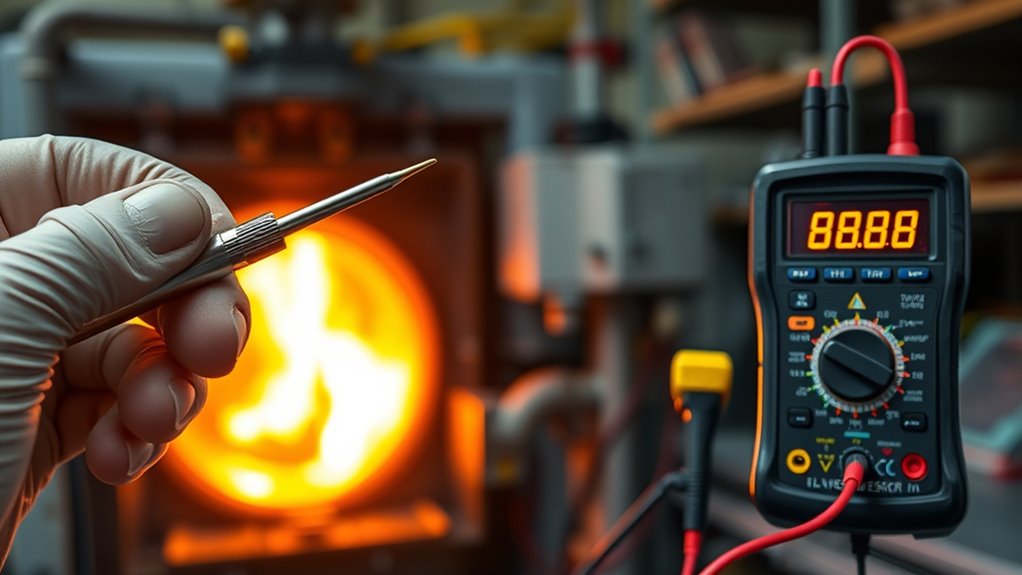
When choosing a thermometer for measuring temperature accurately, understanding the differences between a thermocouple and a thermistor is essential. Both sensors are widely used, but they serve different purposes depending on your specific needs. Sensor accuracy is a key factor, as it determines how close your readings are to the true temperature. Thermocouples generally provide a broader temperature range and are reliable over wide spans, but their accuracy can sometimes be less precise than thermistors within certain ranges. Thermistors, on the other hand, excel in providing high sensor accuracy within a narrower temperature scope, making them ideal for applications where precision is critical.
Choosing between thermocouples and thermistors depends on your accuracy and temperature range needs.
Response time is another important aspect to contemplate. Thermocouples tend to respond quickly to temperature changes, making them suitable for dynamic environments where rapid measurements are necessary. Their fast response time allows you to monitor fluctuations in real time, which is crucial in industrial processes, scientific experiments, or safety monitoring. Thermistors usually have a slower response time because their resistance changes more gradually, but this can be advantageous in situations where temperature stability is more important than immediate responsiveness. If you need quick readings to adjust processes swiftly, a thermocouple might be your best choice; if you’re aiming for precise measurements over a stable period, a thermistor could serve you better.
Another factor to weigh is the environment in which you’ll be measuring temperatures. Thermocouples are more durable and can withstand harsher conditions, including high temperatures, vibrations, and corrosive environments. This robustness makes them suitable for industrial settings or outdoor applications. Thermistors, however, are more sensitive and can be affected by environmental factors like humidity or chemical exposure, which might impact their sensor accuracy over time. Additionally, sensor calibration**** is often more straightforward with thermistors, simplifying maintenance and ensuring consistent precision.
Furthermore, ease of use and calibration play roles in your decision. Thermocouples are generally easier to connect to various systems, but they require careful calibration to maintain accuracy. Thermistors often need less complex circuitry and can be calibrated more easily for specific temperature ranges, ensuring you get precise readings consistently.

Thermocouple Thermometer Digital K Type Thermocouple,Dual Channel Thermocouple Tester(-238~3212℉) with 4 K-Type Thermocouples LCD Display Temperature Tester for K/J/T/E/R/S/N Type
- Functional Features: Hold, Max, Min, Avg, Auto-off, Dual screens
- Measurement Compatibility: Supports K/J/T/E/R/S/N thermocouples
- Included Probes: Two K-type probes and stainless steel sensors
As an affiliate, we earn on qualifying purchases.
As an affiliate, we earn on qualifying purchases.
Frequently Asked Questions
How Do Calibration Processes Differ Between Thermocouples and Thermistors?
You calibrate thermocouples by comparing their voltage output to a known temperature, focusing on calibration accuracy and accounting for material stability issues that may affect performance over time. For thermistors, you measure their resistance at specific temperatures, ensuring calibration accuracy by referencing standardized values. Material stability impacts both devices, but thermistor calibration often involves adjusting for resistance drift, while thermocouples require voltage correction for prolonged use.
What Are the Environmental Limitations of Each Thermometer Type?
You should consider that thermocouples excel in harsh environments due to their high sensor durability and ability to handle extreme temperatures, but they may be affected by environmental exposure to electrical noise. Thermistors, on the other hand, are more sensitive to environmental factors like moisture and chemical exposure, which can impact their accuracy and longevity. Both require proper protection to maximize their performance in specific environmental conditions.
Can Thermocouples and Thermistors Be Used Interchangeably?
You can’t always use thermocouples and thermistors interchangeably because sensor compatibility and signal integration differ. Thermocouples handle higher temperatures and produce millivolt signals, while thermistors are more accurate at lower temps with resistance changes. To guarantee proper readings, you need to match the sensor type with your system’s signal processing capabilities. Using the wrong sensor can lead to inaccurate data and integration issues.
How Do Response Times Compare in Dynamic Temperature Environments?
Imagine you’re trying to catch a quick-moving ball; your response speed matters. Thermistors respond faster than thermocouples in dynamic environments, often within milliseconds, making them ideal for rapid temperature changes. Thermocouples, while slightly slower, are more environment-sensitive and better suited for high-temperature ranges. So, if quick reactions are critical, thermistors give you the edge, but thermocouples excel in harsher, high-temp environments.
What Maintenance Is Required for Thermocouple Versus Thermistor Sensors?
You need to regularly check both sensors for sensor longevity, guaranteeing they’re functioning correctly. For thermocouples, inspect the wiring and connections, replacing any corroded or damaged parts promptly. Thermistors require calibration checks and may need replacing if their readings drift. Follow proper replacement procedures to ensure accuracy and safety. Routine maintenance helps extend each sensor’s lifespan, minimizes downtime, and maintains precise temperature measurements in your applications.

Sper Scientific Large Display Temperature Monitor 800116 – High Accuracy Thermistor Probe, Extra-Large Readable Display, Waterproof, 19” Probe with Clamp for Food Processing, Boilers & Grain
- Large Display: 1.5-inch high digits for easy reading
- High-Accuracy Probe: 19-inch thermistor with clamp
- Waterproof Design: IP67 rated for wet environments
As an affiliate, we earn on qualifying purchases.
As an affiliate, we earn on qualifying purchases.
Conclusion
Choosing between a thermocouple and a thermistor thermometer depends on your needs, but knowing their differences helps you pick the right one. Did you know thermocouples can measure temperatures up to 1,800°C, making them perfect for extreme environments? Meanwhile, thermistors excel in precision at lower temperatures. Understanding these stats guarantees you get accurate readings for your specific tasks, whether in industrial settings or household use. Make your choice wisely, and you’ll always stay on top of your temperature monitoring.

2-Pack TL3163K K-Type Thermocouple Air Probes Stainless Steel Open-End Clamp
- Product Type: TL3163K K-Type Thermocouple Probes
- Temperature Range: -40°F to 875°F
- Design Feature: Open hole clip design
As an affiliate, we earn on qualifying purchases.
As an affiliate, we earn on qualifying purchases.

10K NTC Thermistor Probe with 1% High Precision, 2 – Meter PVC Wire with Terminals, Suitable for Water Dispenser, Air Conditioners, Refrigerators (2 Meter/ 6.56 ft)
- High Precision: 1% accuracy for accurate temperature measurement
- Versatile Use: Suitable for appliances like ACs and refrigerators
- Durable Encapsulation: Nickel-plated copper with double-layer sealing
As an affiliate, we earn on qualifying purchases.
As an affiliate, we earn on qualifying purchases.