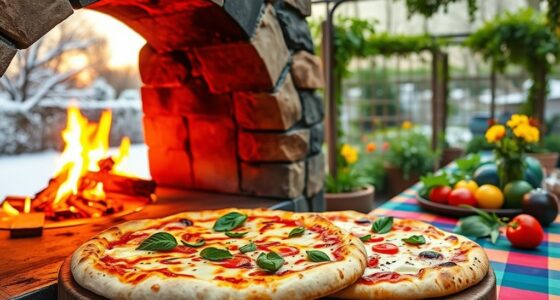
To get a leopard-spotted crust, start by preheating your oven to at least 500°F (260°C) with a pizza stone or steel inside. Use high hydration dough (around 70-80%) to promote rapid browning and blistering. Bake quickly, about 7-10 minutes, monitoring closely for dark patches. For extra spots, briefly broil at the end. Maintaining consistent, intense heat is key—keep going, and you’ll discover how to perfect those distinctive spots.
Key Takeaways
- Preheat your oven to at least 500°F (260°C) with a pizza stone or steel for consistent, intense bottom heat.
- Use dough with 70-80% hydration to promote steam and rapid browning for dark, spotted crusts.
- Bake quickly for 7-10 minutes, monitoring closely to develop dark patches without burning.
- Maintain high oven temperature throughout baking, and consider briefly broiling at the end for enhanced spots.
- Ensure thorough preheating and even heat distribution to encourage Maillard reaction and caramelization for leopard spots.

If you want your bread or pizza crust to have a striking leopard-spotted appearance, mastering the art of proper baking techniques is vital. Achieving those dramatic, dark spots requires careful attention to oven temperatures and dough hydration. High heat is your best friend here, but it’s not just about cranking up the temperature. You need to understand how oven temperatures influence the Maillard reaction and caramelization, which create the rich, dark patches characteristic of a leopard-spotted crust. Preheat your oven thoroughly—at least 500°F (260°C)—to guarantee it’s hot enough to produce those high-heat effects quickly. Using a pizza stone or steel can help maintain consistent, intense heat from the bottom, promoting even browning and spotting. Remember, an oven’s heat distribution can vary, so monitor your crust closely to avoid burning.
Dough hydration plays a vital role as well. A dough with higher hydration—around 70-80%—tends to be more elastic and capable of developing those appealing dark spots. The extra moisture in the dough creates a steamy environment inside the oven, which encourages rapid browning and crust blistering. This moisture also helps the crust to expand quickly, forming irregular bubbles and dark patches. To achieve the perfect hydration, weigh your ingredients precisely and mix until the dough is smooth and slightly sticky, but not overly wet. Proper hydration ensures that the crust will develop a good crust-to-crumb contrast and that the spots will form naturally during baking.
Timing and baking technique are equally important. Bake at high heat for a shorter period, around 7-10 minutes, depending on your oven and the thickness of your dough. Keep a close eye on the crust as it bakes—those dark patches can develop quickly once the oven hits the right temperature. To enhance the leopard spots, you can also use a broiler briefly at the end of baking, but do so with caution to prevent burning.
Frequently Asked Questions
Can I Achieve Leopard-Spotted Crust With Any Oven Type?
You can achieve a leopard-spotted crust with most oven types, but oven compatibility plays a role in pattern consistency. High-heat ovens, like traditional or wood-fired ones, better replicate the conditions needed for that distinctive look. Electric and convection ovens might require adjustments, such as preheating or using a pizza stone. Focus on maintaining consistent high heat to guarantee the pattern stays uniform and authentic across different oven types.
How Long Should I Preheat the Oven for Best Results?
Preheat your oven for at least 30 minutes to guarantee it’s thoroughly heated, especially if you’re aiming for a leopard-spotted crust. Set the oven temperature to 500°F (260°C) or higher, depending on your recipe. This preheating duration allows the oven to reach an even temperature, which is vital for achieving that crust. Keep an eye on your baking duration, typically 10-15 minutes, to prevent overbaking or burning.
Do Different Types of Flour Affect the Crust Pattern?
Think of flour types as the paintbrushes for your crust’s masterpiece. Different flours, with varying protein contents, influence gluten development and texture. Bread flour, with higher protein, creates a sturdier crust that can develop those beautiful leopard spots, while lower-protein flours like all-purpose may result in a softer, less patterned crust. Experiment to find the flour that helps your dough achieve that perfect, spotted crust you’re aiming for.
Is It Necessary to Use a Baking Stone or Steel?
You don’t need a baking stone or steel, but they markedly improve heat retention and provide a consistent, high heat environment. Using a sturdy baking surface like a preheated stone or steel helps create the intense heat needed for that leopard-spotted crust. Without them, you’d rely on your oven’s rack, which might not retain heat as well, making it harder to achieve the same crust pattern.
Can I Replicate the Pattern With a Baking Spray?
Think of baking spray patterns as your canvas’s secret whispers, hinting at your crust’s leopard spots. You can’t truly replicate the natural leopard-spotted crust with baking spray alone, but you can use crust design techniques by spraying or painting specific areas before baking. This method adds contrast and creates a unique pattern, giving your bread that wild, spotted look. Just be precise and creative—your crust will tell a story.
Conclusion
Achieving that perfect leopard-spotted crust isn’t just about looks—it’s about mastering high heat techniques. When you get it right, you’ll enjoy a beautifully caramelized, flavorful crust every time. Did you know that high heat can increase browning reactions by up to 50%, enhancing taste and texture? So, keep experimenting with your oven’s heat and timing. With patience and practice, you’ll consistently create stunning, restaurant-quality crusts that impress everyone at your table.