TL;DR
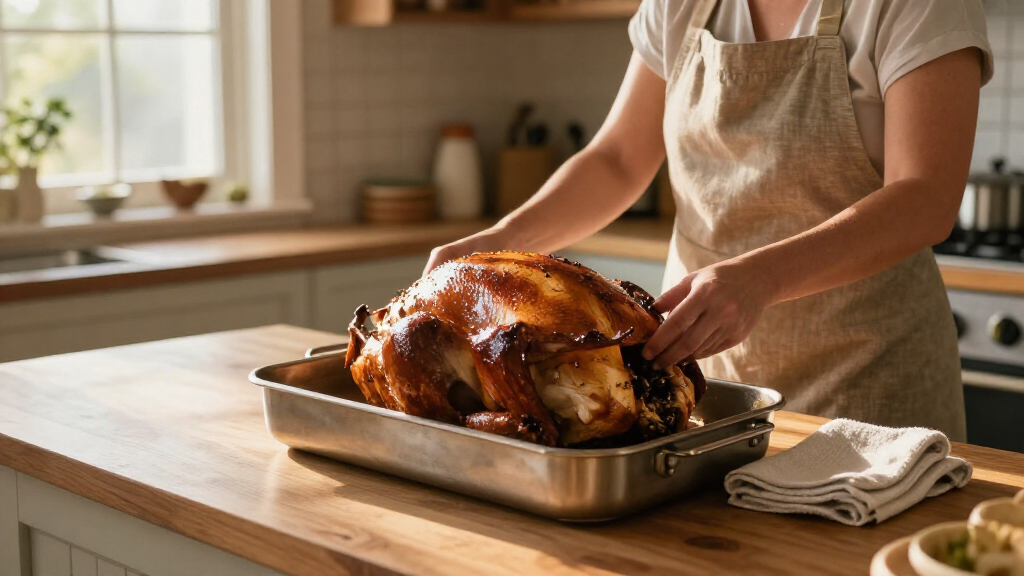
A turkey roasting pan holds the bird and catches its drippings for gravy, but its size, material, handles, and stovetop rating matter as much as its capacity. Measure your oven and the pan’s inside dimensions, leave room around the turkey, and support thin disposable pans on a sturdy baking sheet. A rack helps air circulate underneath the bird, though vegetables can lift it just as well.
The turkey can fit in the pan and still fail the most important test: fitting through your oven door with room for heat to move around it. A roasting pan that looked generous on a store shelf can crowd the bird, scrape the oven walls, or spill hot juices when you lift it.

Get kitchen gear delivered free with Prime
- Fast, free delivery on millions of items
- Prime Video, Amazon Music and more included
- Member-only deals all year
This guide explains what a turkey roasting pan actually needs to do, how to match its dimensions to your bird and oven, and what materials can handle gravy-making or easier cleanup. You’ll also get practical steps for using a rack, moving a full pan safely, and deciding when a disposable option will do the job.
Measure both your oven and the pan’s interior; bird weight alone does not guarantee a fit.
Choose sturdy handles and a stable base so you can lift the loaded pan securely.
A rack helps lift the turkey, but carrots, celery, and onions can provide a practical substitute.
Support a thin disposable pan on a sturdy baking sheet before filling and keep it supported while moving.
Use a roasting pan on the stovetop only when the manufacturer says it is safe.
Choose a pan that fits the bird and leaves room for heat
A turkey roasting pan holds the bird, catches its juices, and gives hot air room to circulate around the meat. Fit is a balance: the turkey needs enough space that it is not pressed against the sides, but the pan should not be so oversized that its drippings spread into a thin film. That film can dry or scorch more readily, while a crowded bird is harder to position and lift and can block circulation around parts of the meat.
Imagine a broad, 16-pound turkey in a pan that technically holds its weight but leaves almost no space at either end. The weight label may suggest the pan is suitable, yet the bird’s actual shape can make it awkward to turn or remove. At the other extreme, a much larger pan gives the drippings more surface area to spread over; this can leave less concentrated liquid for gravy and may expose more of it to scorching. The useful fit is therefore about dimensions and shape, not a single pound rating.
Check the pan’s interior length and width, since those describe the cooking area, and its depth, which affects how well it contains juices. Then check the widest exterior point, including handles, against the oven’s usable width and depth. A flat, stable bottom helps the pan sit level, and handles you can grip with oven mitts make it easier to control the load. Moderate sides contain splashes while leaving room for heat to reach the bird; very high sides may make access awkward and can shade the lower sides of the turkey.
Measure the oven with its racks in the position you plan to use, and account for rails, a protruding light, and the door opening. A pan that fits the cavity but catches on the oven frame can be difficult to insert and especially risky to remove when full. Labels and dimensions are not standardized across brands, so compare the actual measurements rather than relying on a capacity claim. A small margin around the pan also makes it easier to slide in and out without scraping or tilting it.
Products Worth Considering

Ninja Crispi 4-in-1 Portable Glass Air Fryer, Grey, FN101GY

Weber Traveler Portable Propane Gas Grill with Wheels, Black

KitchenAid 13-Cup Food Processor, KFP1318BM, Black Matte
As an affiliate, we earn on qualifying purchases.
Match the pan material to how you cook and clean
Pan material affects more than durability: it changes how much the loaded pan weighs, how evenly it heats, how you can make gravy, and how much care cleanup requires. Stainless steel is durable and nonreactive, and many models can go from oven to burner when the manufacturer approves it. A heavy base helps spread heat and reduce hot spots when you brown aromatics or deglaze the pan. That stability is useful for gravy, though the pan’s weight matters when it is already holding a turkey and hot liquid.
Aluminized or carbon steel often costs less and weighs less, which can make handling easier, but its coating may scratch or wear. Enameled steel wipes clean easily and looks tidy on the table; a chip can expose the metal underneath, so careless stacking or abrasive cleaning can shorten its useful life. Cast iron holds heat beautifully, which can help with browning, but a large cast-iron pan loaded with a turkey and steaming juices can be difficult to lift safely. The heat retention that helps cooking also means the pan stays hot longer after it leaves the oven.
Nonstick coatings can make release and cleanup easier, but metal utensils, abrasive pads, and excess heat can damage them. Check the temperature limit and stovetop guidance rather than assuming every nonstick pan works for gravy. This creates a practical tradeoff: a pan optimized for easy cleanup may have limits on high-heat browning or burner use, while a robust stovetop-safe pan may need more careful washing. A Sunday cook who regularly roasts vegetables may value easy cleanup, while a gravy devotee may prefer sturdy, stovetop-safe stainless steel.
Disposable aluminum pans suit occasional cooks because they are inexpensive and require no storage afterward, but thin walls can buckle under a heavy bird. Set one on a strong baking sheet before filling it, then move the sheet and pan together. The extra support reduces flexing, though it also means handling a larger combined load. Whatever the material, follow its specific oven, burner, and care instructions; the material name by itself does not establish that a pan is safe for every heat source.
Use a rack or vegetables to lift the turkey above the juices
A roasting rack raises the turkey above its drippings so hot air can reach more of the underside. This can help the skin brown more evenly and keep it from sitting in liquid, but it does not guarantee crisp skin or replace other parts of a recipe. A rack is useful when you want the bird elevated and the drippings accessible beneath it; it is not required if you accept less browning underneath.
For a simple substitute, spread thick pieces of carrot, celery, and onion across the pan bottom. They act like a low, uneven platform, keeping much of the skin out of pooled juices while contributing flavor to the drippings. Unlike a rigid rack, vegetables soften as they cook, so they may not hold the bird at a uniform height. That is usually a reasonable tradeoff when the goal is to lift the turkey and enrich the liquid rather than achieve a perfectly level support. Picture lifting a golden turkey from those vegetables after roasting: the onions are soft and dark at the edges, and the kitchen smells like thyme and warm stock.
If your pan includes a rack, check that it sits securely and supports the turkey without tipping. A rack that is too narrow can wobble when you lift the bird, turning a browning aid into a handling hazard. One that blocks the pan’s handles can also make it harder to grip the pan safely. Choose a rack that fits the pan’s shape and leaves access to its handles; turkey weight alone does not tell you whether the rack will sit steadily.
When you roast directly in the pan, the underside is more likely to stay moist where it contacts the pan or liquid, so expect less browning there. Monitor the liquid and browning underneath, follow your recipe’s approach to adding broth or vegetables, and avoid letting a shallow layer of drippings dry out. If you add liquid to a hot pan, pour carefully because steam can rise quickly and burn exposed skin.
Move a full roasting pan without spilling hot drippings
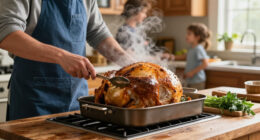
A full roasting pan is heavy, hot, and easy to tilt, so prepare your route before you pull it from the oven. The drippings make the load shift when the pan tips, and a flexible pan can bend under that changing weight. Clear the counter, put down a heatproof landing spot, secure your oven mitts, and use both hands on the handles. These steps help you keep the pan level and avoid having to navigate around obstacles while carrying it.
For example, if you roast a large turkey in a thin aluminum pan, do not lift the pan by its rim and hope it holds. Place it on a sturdy rimmed baking sheet before filling, and keep that support underneath as you move it. The sheet spreads the load and helps stop the pan from folding, although the combined pan, sheet, bird, and liquid may be heavier than the pan alone. Plan the lift around that full weight rather than assuming the support makes it effortless.
Set the pan down before reaching for utensils or carving tools. If you need to move it to the stovetop for gravy, confirm first that the manufacturer approves burner use and that the pan sits securely over the burner. A pan that rocks or overhangs a small burner may heat unevenly and spill more easily. Glass or ceramic dishes should not go over direct heat unless their makers explicitly allow it.
Hot drippings can splash and burn, and a sudden temperature change can warp or damage cookware. Let the pan cool as directed before washing. Treat a heavy roast as a deliberate, two-handed lift: a clear path and stable landing spot reduce the chance of a rushed correction while carrying hot liquid.
Make gravy with browned bits only if the pan is burner-safe
Stovetop-safe pans let you loosen browned bits from the bottom with liquid and build gravy right where the turkey roasted. Those browned bits, called fond in many recipes, add a deep, savory flavor because they concentrate juices and browned ingredients from cooking. But a pan’s material name alone does not tell you whether it belongs over a burner: its construction, coating, and handles all matter, so check the manufacturer’s instructions.
After roasting, a cook might pour off excess fat, set an approved stainless pan over a suitable burner, and stir in stock to release the brown layer. That saves a transfer and makes the most of the turkey’s drippings. A broad, stable base helps the pan sit evenly, while strong handles give you a secure grip with mitts. The tradeoff is weight and burner fit: a large pan may not sit securely on a small burner, and a heavy pan full of hot liquid is harder to control while stirring.
Some metal pans are not designed for direct heat, and nonstick coatings may have limits on high heat or stovetop use. Using an unapproved pan can damage its finish or make it unstable over the burner. Never put glass or ceramic cookware over a flame or hot burner unless the maker specifically says it is safe. If your roasting dish cannot go on the stovetop, transfer the drippings to a suitable saucepan; that adds a step, but lets you make gravy in cookware designed for the heat source.
What a roasting pan can do depends on its design and stated compatibility. A versatile pan may earn its cupboard space with roasts, vegetables, and gravy, particularly if those are jobs you do often. A pan intended only for oven use can still make an excellent turkey, especially if you have a saucepan for gravy. Pick based on the jobs you will actually ask it to do, since extra versatility matters less if it makes the pan too heavy or costly for your usual cooking.
Clean stuck-on drippings without damaging the finish
Gentle soaking often loosens stuck-on drippings without scraping the pan or damaging a coating. Once the roasting pan has cooled according to its care instructions, add warm, soapy water and let residue soften. The soak gives dried-on juices time to release, so you can use less force. A nonabrasive sponge can usually lift what remains, while a harsh scouring pad may leave scratches on coated surfaces.
Think of the dark glaze left after roasting as sugar stuck to the bottom of a roasting dish: scraping hard straight away can turn a simple cleanup into a scratched finish. Instead, give the residue time to loosen, then wash with tools suited to the material. Follow the care guide if the pan has a coating or enamel, since damage there can make later cleanup harder.
Do not plunge a very hot pan into cold water. Sudden temperature shifts can warp some pans or damage certain finishes. Waiting for the pan to cool helps protect it, and if the first soak leaves a stubborn patch, repeating the warm-water soak is safer than immediately reaching for an abrasive cleaner.
Care varies by construction, so there is no single rule for every pan. Check whether its maker allows dishwasher cleaning, which utensils it can handle, and how hot it can safely get. A little attention after the roast helps preserve the finish and keeps a useful pan ready for vegetables, a brisket, or next year’s turkey.
Frequently Asked Questions
What size roasting pan do I need for a turkey?
Choose a pan that fits the turkey with some room around it and also fits your oven. Compare the pan’s inside dimensions and widest point with the oven’s usable space; turkey weight by itself does not guarantee a good fit.
Can I roast a turkey without a roasting pan?
Yes, if you have a sturdy oven-safe dish deep and strong enough to hold the bird and its drippings. A rimmed baking sheet may work better for turkey parts or a smaller bird than for a large whole turkey.
Do I need a rack in my turkey roasting pan?
No. A rack lifts the bird above the juices and helps heat reach underneath, but a bed of sturdy carrots, celery, and onions can serve as a support. Roasting directly in the pan also works, though the underside may brown less.
Can I use a disposable aluminum pan for a whole turkey?
Yes, but thin disposable pans can bend under a heavy bird and spill hot drippings. Place the pan on a sturdy baking sheet before filling and keep it supported as you move it.
Can I put my roasting pan on the stovetop to make gravy?
Only if the manufacturer says the pan is safe for stovetop use and it sits securely on the burner. If it is not approved, transfer the drippings to a suitable saucepan; do not use glass or ceramic over direct heat unless its maker permits it.
Conclusion
Choose a pan by checking the fit, the weight you can handle, and the jobs you want it to do after roasting. If it fits your oven, supports the turkey securely, and suits your gravy and cleanup routine, it is ready for the feast.
Measure before you buy, then clear the counter before the bird comes out. That way, the only thing spilling through the kitchen is the warm smell of roast turkey.