To measure your pizza stone’s temperature accurately, choose a heat-resistant thermometer suited for your oven type, such as a digital probe or analog dial. Place the sensor directly on the stone, ensuring it’s stable and away from flames or drafts. Check regularly, calibrate as needed, and avoid quick, surface-only tests with infrared thermometers. Proper placement and consistent monitoring help you control the perfect temperature for pizza baking. Keep reading to learn more tips and techniques.
Key Takeaways
- Use a heat-resistant digital or analog thermometer designed for high temperatures to ensure accurate readings of your pizza stone.
- Place the thermometer probe perpendicular and directly on the stone’s surface, away from flames or hot spots.
- Calibrate the thermometer regularly using boiling water or reference materials to maintain measurement accuracy.
- Position the sensor on the oven’s hot spot or center for consistent temperature monitoring, avoiding drafty or uneven areas.
- Take multiple readings over time to track temperature fluctuations and ensure your stone maintains the ideal baking temperature.

Walfos Silicone Trivet Mats - 4 Heat Resistant Pot Holders, Multipurpose Non-Slip Hot Pads for Kitchen Potholders, Hot Dishers, Jar Opener, Spoon Holder, Food Grade Silicone & BPA Free (Black)
NON-SLIP AND HIGH HEAT RESISTANT: These trivets for hot dishes are heat-resistant from -104℉ to 446℉, Protect your...
As an affiliate, we earn on qualifying purchases.
Types of Pizza Oven Thermometers and Their Differences
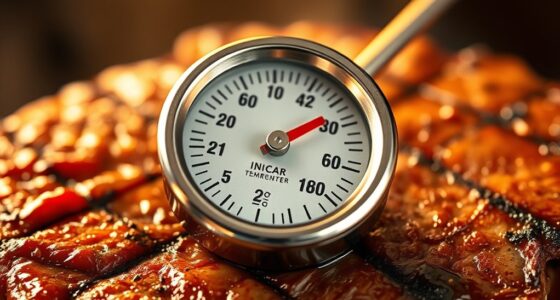
When choosing a pizza oven thermometer, it’s important to understand the different types available and how they differ. Material differences play a key role, as digital thermometers often feature sleek, durable probes made from stainless steel, while analog models typically use metal dials with glass covers. Digital thermometers provide quick, precise readings and are easy to read, especially in low light. They often include features like temperature memory and alarms. Analog thermometers, on the other hand, are simple, reliable, and don’t require batteries, making them a cost-effective choice. They usually have a dial with a pointer indicating temperature. Your choice depends on your preferences for ease of use, accuracy, and durability, but both types can give you accurate measurements when used correctly.

Kodreat 4 Pack Silicone Trivets for Hot Dishes, Heat-Resistant Non-Slip Hot Pads for Kitchen Countertops and Tables, Food-Grade Thick Silicone Mats (Black)
Heat-Resistant Silicone Trivets for Hot Pots & Pans – Protect your countertops, tables, and kitchen surfaces from extreme...
As an affiliate, we earn on qualifying purchases.
Choosing the Right Thermometer for Your Oven

Choosing the right thermometer depends on understanding the different types available and how accurately they measure your oven’s temperature. You’ll also want one that responds quickly and works well with your specific oven type. Considering these points guarantees you pick a thermometer that delivers precise readings every time.
Types of Thermometers
Selecting the right thermometer for your pizza oven is essential to achieving perfect results. You have two main options: digital probes and analog gauges. Digital probes are versatile, providing quick readings and easy-to-read displays, often with remote monitoring options. They’re ideal if you want precise control and real-time updates. Analog gauges, on the other hand, are simple, durable, and don’t rely on batteries or electronics. They’re great for straightforward monitoring and are generally more affordable. Both types can effectively measure oven temperature, but your choice depends on your preferences for convenience, accuracy, and budget. Consider how you plan to use the thermometer, and select a model that fits your needs for consistent, accurate stone temperature readings.
Accuracy and Response Time
To get accurate and timely temperature readings, it’s important to contemplate how quickly and precisely your thermometer responds. Sensor accuracy determines how close your readings are to the actual stone temperature, which is essential for consistent pizza results. A thermometer with high sensor accuracy minimizes errors, ensuring you’re cooking at the perfect heat. Response time is equally critical; a fast response allows you to make quick adjustments, especially when preheating or managing high temperatures. Slow response times can lead to inaccurate readings, causing you to over- or under-heat your oven. Look for thermometers with proven quick response times and reliable sensor accuracy to maintain ideal stone temperature. This combination ensures you can monitor and control your oven’s heat effectively, delivering perfect pizzas every time.
Compatibility With Oven Types
Since oven types vary considerably, it’s vital to find a thermometer compatible with your specific setup. Different ovens require different materials to guarantee oven safety and proper function. For example, high-temperature pizza ovens often demand thermometers made from heat-resistant materials like stainless steel or ceramic, which can withstand extreme temperatures without degrading. If you have a wood-fired or brick oven, confirm the thermometer can handle fluctuating heat levels and is designed for outdoor use. Electric or gas ovens may need probes compatible with their control panels. Always check the material compatibility to prevent damage or inaccurate readings. Selecting a thermometer suited for your oven type ensures accurate temperature measurement, promotes oven safety, and helps you achieve perfect pizza crusts every time.
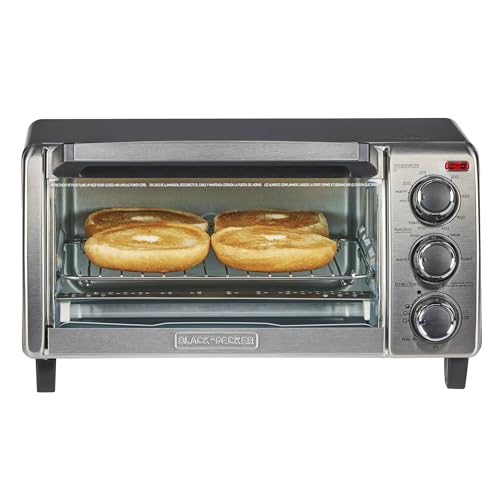
BLACK+DECKER TO1313SBD Toaster Oven, 15.47 Inch, Silver
ACCOMMODATES 9-INCH PIZZA OR 4 SLICES OF BREAD – Designed to maximize utility within a compact footprint, the...
As an affiliate, we earn on qualifying purchases.
Understanding the Ideal Pizza Baking Temperature

To get that perfect pizza crust, you need to know the ideal baking temperature, usually between 450°F and 500°F. Several factors, like your oven type and pizza style, can influence the optimal temperature. Understanding these points helps you achieve consistent, restaurant-quality results at home.
Optimal Baking Range
Achieving the perfect pizza crust depends on maintaining the right oven temperature. Your goal is to keep the stone temperature within the ideal baking range, typically between 700°F and 900°F for most wood-fired or pizza ovens. This range ensures your dough cooks quickly, developing a crispy crust with a tender interior. If the temperature is too low, your pizza may turn out doughy or undercooked; too high, and it risks burning. Use your thermometer to monitor the stone temperature constantly, adjusting the heat source as needed. Staying within this *essential* baking range helps you achieve consistent results, *guaranteeing* every pizza has that perfect balance of crunch and chew. Mastering this temperature window is *vital* for professional-quality results.
Factors Affecting Temperature
Several factors influence the temperature inside your pizza oven, directly affecting how your pizza cooks. Humidity fluctuations can cause uneven heat distribution, making it harder to maintain a consistent stone temperature. High humidity levels can slow down the evaporation process, resulting in a softer crust, while low humidity can lead to a crispier outcome. Ambient temperature also plays a pivotal role; warmer surroundings can increase oven temperature, while cooler environments may require more time to reach your desired heat level. Additionally, external weather conditions, door openings, and oven insulation impact how quickly your oven heats and retains heat. Understanding these factors helps you better control oven temperature, ensuring your pizza bakes evenly and achieves that perfect crust every time.

Elite Gourmet ETO236 Compact 2-Slice Toaster Oven, 15-Min Timer, Black
COMPACT & SPACE SAVING: Versatile compact design fits nicely in small spaces when counter space is limited.
As an affiliate, we earn on qualifying purchases.
How to Properly Place a Thermometer in Your Pizza Oven
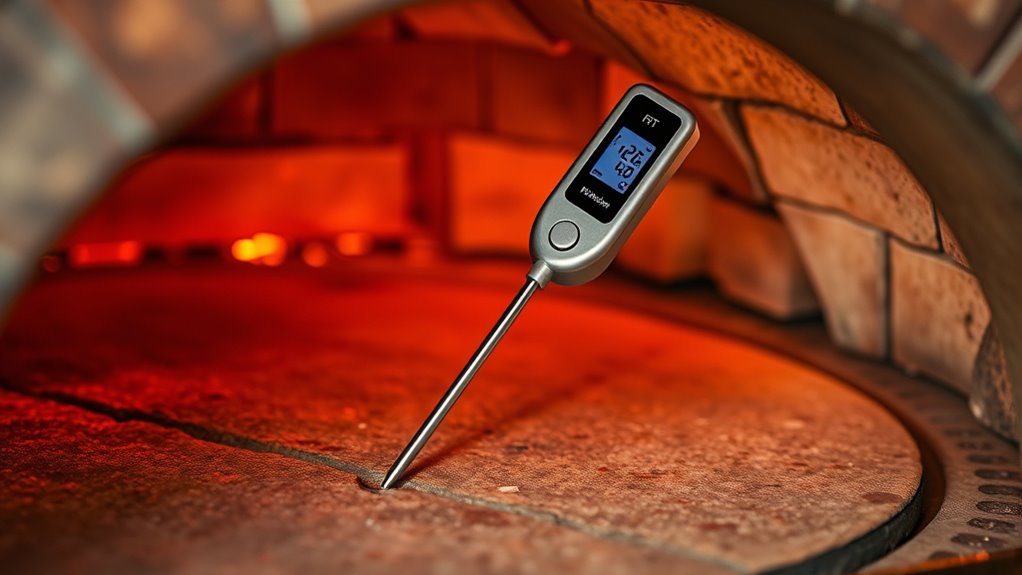
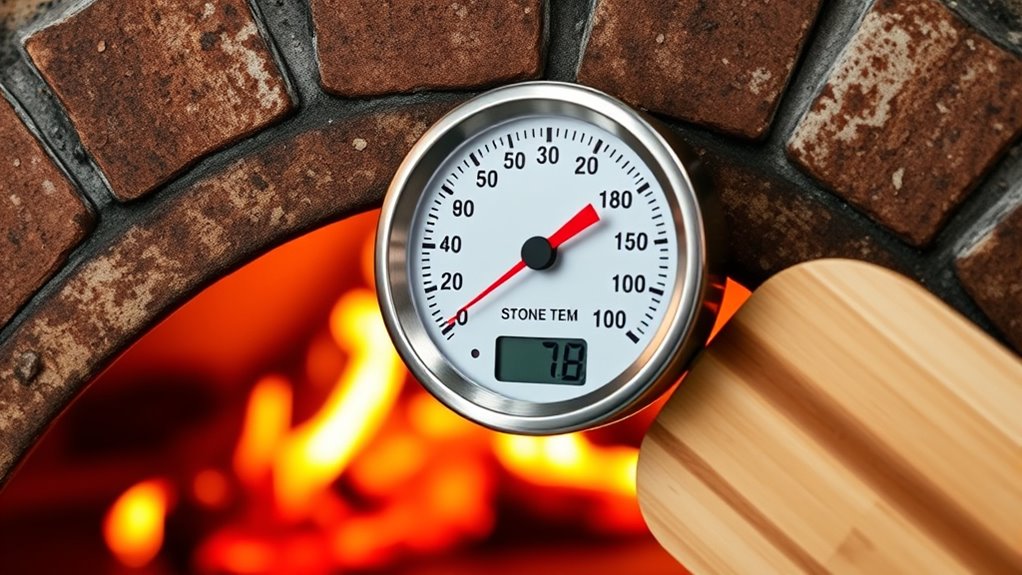
Placing your thermometer correctly in a pizza oven is essential for accurate temperature readings. Proper thermometer placement helps you understand the oven’s heat distribution, ensuring your pizza cooks evenly. Position the thermometer away from direct flame or intense heat sources to avoid skewed readings. For wood-fired or brick ovens, place it near the dome’s center or just below the ceiling, where heat accumulates. In gas or electric ovens, position the thermometer at the level where your pizza will cook. Keep the probe stable and secure, avoiding drafty spots or areas with inconsistent airflow. Remember, temperature can vary across different oven zones, so placing the thermometer in the correct spot will give you the most reliable data to achieve perfect pizza results.
Step-by-Step Guide to Measuring Stone Temperature
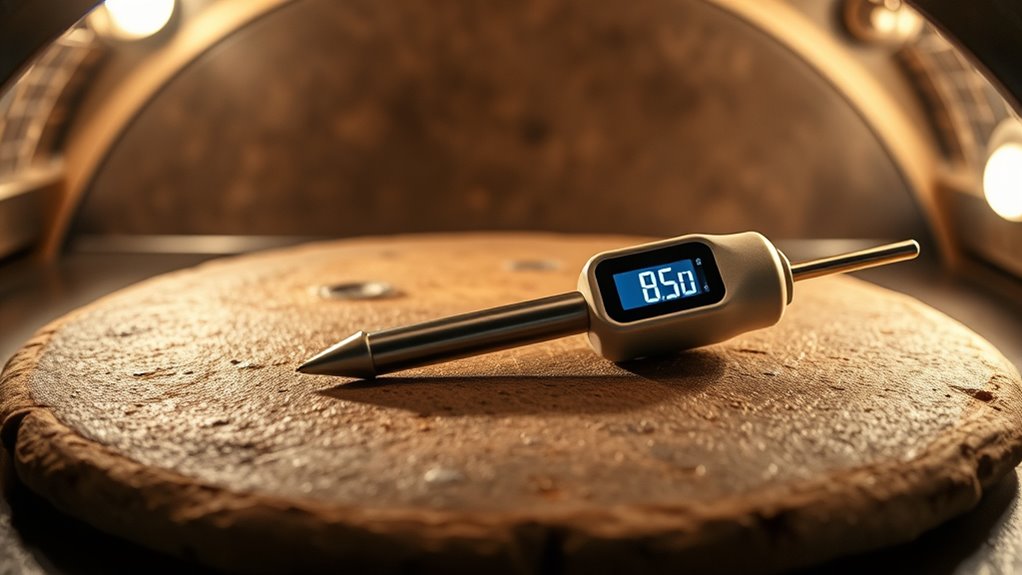
To get an accurate reading of your pizza stone’s temperature, you need to place the thermometer properly. Once you have the right spot, you’ll learn how to interpret the temperature readings correctly. This step guarantees your pizza cooks evenly and turns out perfect every time.
Proper Thermometer Placement
Ensuring accurate temperature readings begins with proper thermometer placement. Correct placement techniques are essential to get reliable readings of your stone’s temperature. Start by positioning the sensor where the heat is most intense, typically near the center or the hot spot of the oven floor. Avoid placing the thermometer too close to the fire or on uneven surfaces, which can skew results. Consistent sensor positioning helps track temperature changes over time, providing a clear picture of your oven’s heat. Keep these points in mind:
- Place the sensor directly on or just above the stone.
- Avoid areas with direct flames or ash.
- Use stable surfaces to prevent movement.
- Ensure the sensor is perpendicular to the stone’s surface.
- Check placement regularly for consistency.
Proper placement techniques ensure your thermometer provides the most accurate readings possible.
Interpreting Temperature Readings
How can you accurately interpret your pizza oven’s temperature readings? First, understand that temperature fluctuations are normal, so don’t panic if readings vary slightly. To get consistent results, use proper calibration techniques regularly, like comparing your thermometer’s reading with a known accurate device. When reading the temperature, consider the heat source and ambient conditions, which influence stone temperature. If readings seem inconsistent, recalibrate your thermometer or replace it if necessary. Keep in mind that a single reading isn’t enough—take multiple measurements over time to identify patterns. By understanding how to interpret fluctuations and maintaining calibrated equipment, you’ll ensure your oven is at the ideal temperature for perfect pizzas every time.
Common Mistakes to Avoid When Checking Temperature

One common mistake when checking your pizza oven’s temperature is placing the thermometer in the wrong spot. This can lead to inaccurate readings, especially if you ignore factors like oven insulation and thermal conductivity. For example, placing the thermometer too close to the flame or in a poorly insulated area can give misleading results. To avoid this, consider these points:
- Place the thermometer on the stone’s surface, not the oven walls.
- Avoid spots with direct heat, which can skew readings.
- Check the thermometer’s calibration regularly.
- Don’t rely solely on one reading; measure multiple spots.
- Remember that oven insulation influences heat retention, affecting temperature consistency.
Being precise helps ensure your pizza cooks perfectly without over- or under-heating.
Using Infrared Thermometers for Quick Readings
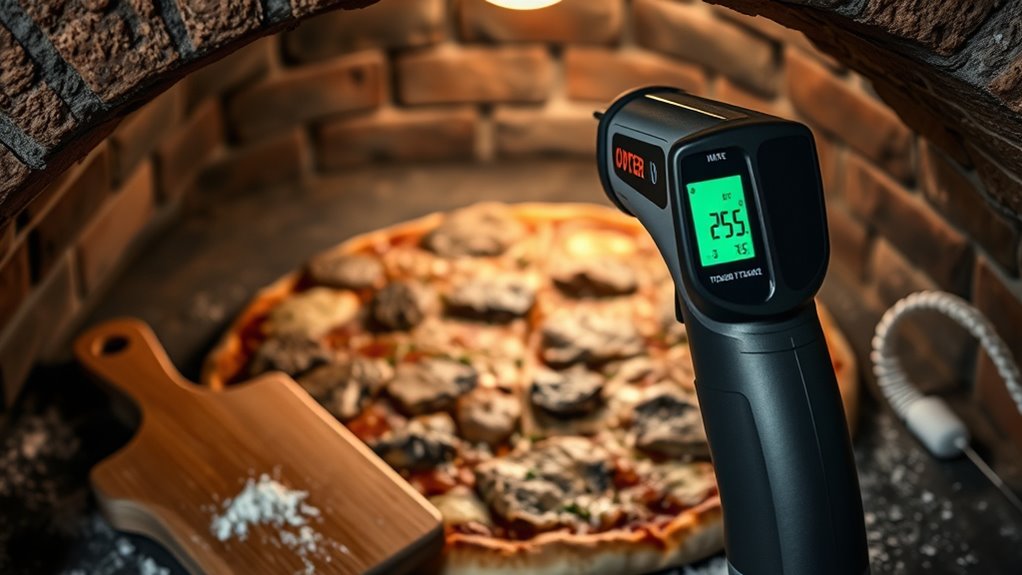
Infrared thermometers offer a fast and convenient way to check your pizza oven’s temperature without the wait involved with traditional probes. They work by detecting infrared radiation emitted from the oven surface, providing instant readings. While infrared accuracy can vary based on the thermometer quality and surface reflectivity, choosing a reliable device guarantees precise measurements. To get quick readings, aim the infrared thermometer directly at the stone or oven surface, keeping a consistent distance recommended by the manufacturer. This method allows you to monitor your oven’s temperature quickly, making adjustments on the fly. Keep in mind that infrared thermometers measure surface temperature, so for a complete picture, use them alongside other thermometers for the most accurate results.
Calibrating Your Thermometer for Accurate Results

To guarantee your pizza oven thermometer provides accurate readings, you need to calibrate it regularly. Proper calibration techniques ensure your temperature measurements are reliable, helping you cook perfect pizzas every time. Start by verifying accuracy with a boiling water test: submerge the thermometer in boiling water and check if it reads 212°F (100°C). If it doesn’t, adjust accordingly or note the deviation. For oven thermometers, use a firebrick or infrared thermometer as a reference point. Keep in mind, precision verification is vital to maintain consistency. Regular calibration not only prevents errors but also extends your thermometer’s lifespan. By staying attentive to calibration needs, you ensure your stone temperature readings are precise, giving you confidence with each pizza you bake.
Tips for Maintaining Consistent Oven Heat
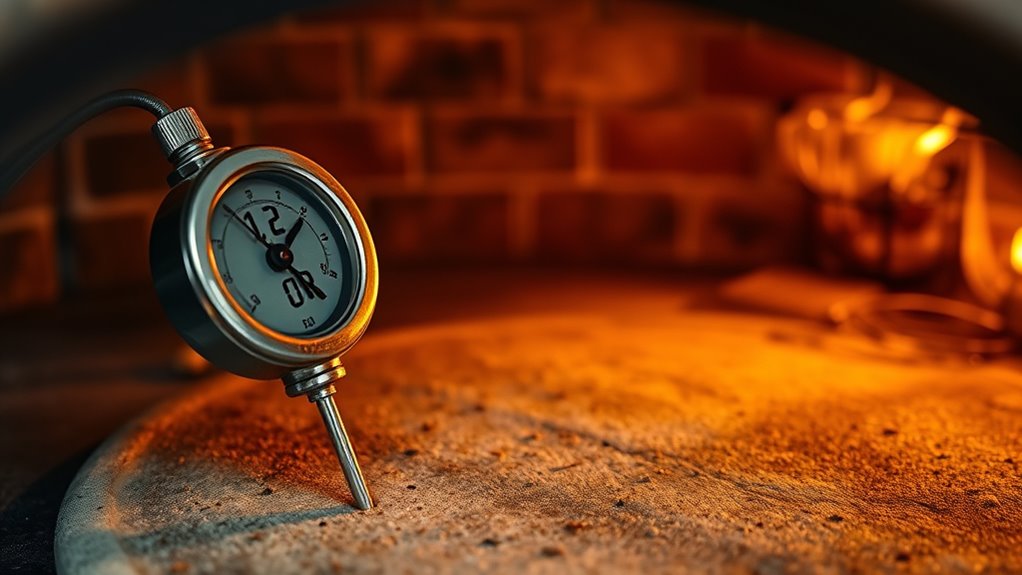
Maintaining a consistent oven heat is key to baking perfect pizzas, especially when you rely on a calibrated thermometer for accurate readings. Seasonal variations can affect your oven’s temperature, so adjust your fire or heating source accordingly. Proper oven insulation plays an essential role; make sure your oven retains heat efficiently by sealing any gaps or adding insulation where needed. Preheat thoroughly, allowing the oven to stabilize before baking. Avoid opening the door too often, which causes heat loss and temperature swings. Keep a close eye on your thermometer to monitor changes and make small adjustments as needed. By managing seasonal effects and maximizing insulation, you’ll maintain steady heat, resulting in evenly cooked pizzas with beautifully crisp crusts.
Troubleshooting Temperature Inconsistencies

When your pizza oven’s temperature readings seem inconsistent, it’s important to identify the underlying cause quickly. Temperature fluctuations often stem from issues like poor oven insulation or faulty heating element maintenance. Insufficient insulation allows heat to escape, causing uneven temperatures and inaccurate thermometer readings. Meanwhile, a worn or damaged heating element struggles to maintain a steady heat, leading to hot spots or cold zones. To troubleshoot, check for gaps or damage in the insulation and ensure the heating element is functioning properly. Regularly maintaining these components helps stabilize temperature readings.
- Inspect oven insulation for gaps or damage
- Clean or replace the heating element as needed
- Use a reliable oven thermometer for comparison
- Avoid opening the oven door frequently during cooking
- Ensure thermostat calibration is accurate
Frequently Asked Questions
How Often Should I Check My Pizza Oven’s Stone Temperature?
You should check your pizza oven’s stone temperature every 15 to 20 minutes to maintain stone temperature consistency. This ideal measurement frequency helps you catch any temperature drops or fluctuations early, ensuring your pizza cooks evenly. Regular monitoring allows you to adjust your heat source as needed. Keep an eye on the thermometer during cooking, especially if you’re baking multiple pies, to achieve perfect results every time.
Can I Use a Regular Kitchen Thermometer for My Pizza Oven?
Can a regular kitchen thermometer give you accurate pizza oven stone temperature? Probably not. Kitchen thermometers are designed for stovetops and ovens with different temperature ranges and may lack the precision needed for pizza stone heat. For the best temperature accuracy, invest in a probe thermometer made for high heat and pizza oven use. This guarantees you get reliable readings, helping you achieve that perfect crispy crust every time.
What Signs Indicate My Stone Temperature Is Too High or Too Low?
If your stone shows signs of cracking or uneven heating, it’s a clear sign that the temperature is too high or too low. Cracks often occur from excessive heat, while uneven cooking indicates inconsistent temperatures. Keep an eye on these signs, and adjust your oven’s heat accordingly. Using a reliable thermometer helps you maintain ideal stone temperature, preventing damage and ensuring perfectly cooked pizzas every time.
How Does Ambient Temperature Affect Oven Stone Temperature Readings?
The ambient impact can subtly influence your oven stone temperature readings, especially during temperature fluctuations. When the surrounding environment gets warmer or cooler, it can cause minor shifts in your stone’s surface temperature, making readings less precise. To get the most accurate results, try to keep your oven in a stable environment, minimize drafts, and allow your oven to preheat fully, ensuring ambient conditions don’t skew your measurements.
Is It Necessary to Monitor Temperature During the Entire Baking Process?
Yes, you should monitor temperature throughout the entire baking process to maintain consistent temperature and thermal stability. This helps prevent hot spots and ensures your pizza cooks evenly. By keeping an eye on your oven stone, you can make adjustments as needed, avoiding over- or under-cooking. Consistent temperature is key to achieving perfect results, so regular monitoring is essential for ideal baking performance and delicious pizza every time.
Conclusion
Now that you know how to measure your pizza oven’s stone temperature accurately, you’re ready to perfect your pies. Just like a chef controls every ingredient, mastering your thermometer guarantees consistent results. It’s easy to get caught up in the art of baking, but without precise heat, even the best toppings can fall flat. So, embrace the tools, stay attentive, and turn your oven into a culinary masterpiece—because precision makes all the difference.