TL;DR

Get kitchen gear delivered free with Prime
- Fast, free delivery on millions of items
- Prime Video, Amazon Music and more included
- Member-only deals all year
Buying an AI workstation can now be just as cost-effective as building one, thanks to component shortages and bulk discounts. The choice hinges on how quickly you need it, how much control you want, and your capacity to manage hardware. In most cases, a hybrid approach offers the best of both worlds.
Imagine this: you need a powerful AI workstation fast, but building it yourself feels like chasing a moving target. Hardware prices have skyrocketed, supply chains are unpredictable, and the whole process can stretch into months. Meanwhile, prebuilt systems arrive ready to run with robust support, tested thermals, and warranties. So, which path makes more sense in 2026? That’s what we’ll explore. The decision isn’t just about money anymore — it’s about speed, control, and risk.
Whether you’re a researcher, startup founder, or enterprise engineer, understanding the real tradeoffs can save you time, money, and headaches. Let’s break down the core factors, compare scenarios, and help you pick the right strategy for your AI ambitions.
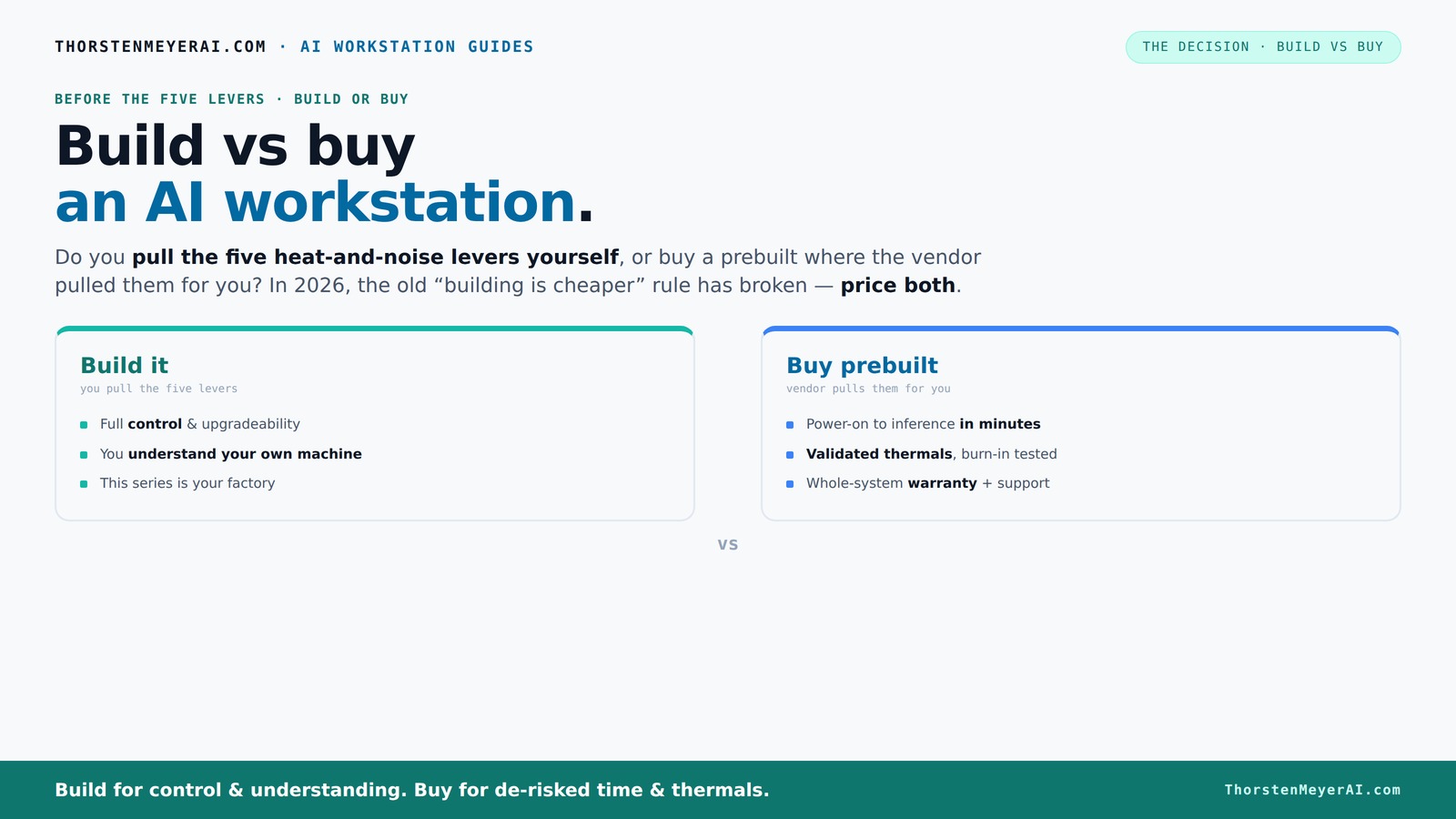
Build vs buy
an AI workstation.
The real question behind this whole series: do you pull the five heat-and-noise levers yourself, or buy a prebuilt where the vendor pulled them for you? And in 2026, the old “building is cheaper” rule has broken. Match your situation in Part 3.
Key Takeaways
- Component shortages and rising prices mean prebuilt AI workstations can now match or beat DIY costs, especially when factoring in time and effort.
- Buying saves critical time—often weeks or months—making it ideal for teams needing rapid deployment.
- DIY offers unmatched control and customization but comes with higher risk, maintenance, and hidden costs that can outweigh savings.
- Hybrid approaches, like buying a system and upgrading specific parts, strike a balance between speed and control.
- Your decision should hinge on workload complexity, timeline, budget, and your team’s technical capacity.
As an affiliate, we earn on qualifying purchases.
Why Building a Custom AI Workstation Isn’t Always Cheaper Anymore
Building your own AI rig used to be a money-saver. But in 2026, the landscape shifted. Components like GPUs, DDR5 RAM, and SSDs now face shortages and steep price hikes, sometimes exceeding 50% since 2024. For more on this, see build vs buy a prebuilt AI workstation. A build that once cost under $1,000 now easily hits $1,250 or more.
Meanwhile, big vendors pre-purchase in bulk before prices spike, giving them leverage to offer systems at prices close to, or even below, DIY parts. This change means that the traditional wisdom—building cheaper for control and customization—no longer applies universally. The implications are significant: if you rely solely on component prices, you might underestimate the value of prebuilt options. The tradeoff now involves not just upfront costs but also time, effort, and the risk of hardware incompatibility or delays. This shifts the decision-making process, making prebuilt systems more attractive even for those who previously considered DIY the cost-effective choice.
According to [2], in 2026, component shortages have driven prices higher, making prebuilt solutions surprisingly competitive on cost. So, don’t assume DIY always wins — the math now requires fresh calculations for each project.
As an affiliate, we earn on qualifying purchases.
The Real Cost of DIY: Time, Complexity, and Hidden Expenses
Building isn't just about buying parts; it’s a complex process that involves multiple stages, each with its own challenges. You might find it helpful to read about building vs buying. Sourcing components can be time-consuming, especially when supply shortages cause delays. Assembling the system requires technical skill to ensure compatibility and optimal performance. Troubleshooting hardware conflicts, BIOS settings, or driver issues can turn into hours or days of frustration—costs often overlooked when just considering hardware prices.
Beyond initial assembly, fine-tuning cooling solutions for quiet operation and thermal stability is critical. High-quality coolers, custom fans, or water cooling setups can add significant time and expense, especially if you’re unfamiliar with these systems. The process of tuning fan curves for noise reduction and thermal efficiency isn’t trivial; it demands patience, expertise, and iterative testing, which can extend project timelines.
Furthermore, ongoing maintenance, firmware updates, hardware upgrades, and troubleshooting form a hidden layer of costs that accumulate over the system’s lifespan. These factors can turn what seems like a cost-saving DIY project into a resource-intensive endeavor. For instance, a misstep in assembly or cooling can lead to hardware failures or reduced performance, requiring repairs or replacements—adding to the total cost and downtime.
Research from [3] shows that the true cost of a DIY AI workstation, factoring in time, effort, and risk, often exceeds the initial hardware investment, especially for complex multi-GPU setups. For more insights, visit build vs buy a prebuilt AI workstation. This highlights the importance of considering not just the initial price but also the operational and opportunity costs involved in DIY approaches.
As an affiliate, we earn on qualifying purchases.
Defining Your Needs: When to Choose Build, Buy, or Hybrid
Before making a decision, it’s crucial to understand your specific needs and constraints. If your project demands rapid deployment, tight budgets, or minimal technical expertise, prebuilt systems often make the most sense. Conversely, if you require highly specialized hardware configurations, maximum control, or plan to upgrade over time, building might still be appealing—though the current market conditions have made this less straightforward.
Hybrid approaches are gaining popularity. For example, you might purchase a prebuilt system but customize or upgrade certain components like adding more RAM or faster SSDs. This strategy allows you to balance speed with control, leveraging the strengths of both options.
Assessing your workload complexity, timeline, available skills, and budget will guide you toward the most suitable approach. You can explore more at build vs buy a prebuilt AI workstation. Consider also future-proofing—will your choice accommodate scaling or evolving AI frameworks? These questions will help clarify whether to build, buy, or adopt a hybrid model.
As an affiliate, we earn on qualifying purchases.
Frequently Asked Questions
Is it cheaper to build or buy a prebuilt AI workstation?
It depends on current market prices and your specific needs. In 2026, component shortages have pushed up DIY costs, making prebuilt systems often just as affordable or cheaper when you factor in time, effort, and risk. Always price both options for your exact configuration before deciding.
How much faster is buying than building?
Buying can reduce deployment time from 12–24 months for a custom build down to as little as 30–60 days, or even a few weeks in some cases. For teams needing quick results, prebuilt systems are a clear advantage.
What hidden costs come with a custom build?
Hidden costs include time spent sourcing parts, troubleshooting, tuning, ongoing maintenance, potential hardware failures, and the learning curve. For detailed guidance, see ice cream and tech guides. These can add up to more than the initial hardware savings, especially for complex multi-GPU setups.
When does a prebuilt system make the most sense?
When speed matters, your team lacks hardware expertise, or you need a reliable, tested setup with warranty support. For example, startups scaling AI workloads quickly or enterprises requiring certified solutions often prefer prebuilt systems.
Can I customize a prebuilt AI workstation?
Yes, but within limits. Vendors often offer configurations and some upgrade options like adding RAM or SSDs. However, deep customization—such as specialized cooling or non-standard hardware—may be limited or require hybrid approaches.
Conclusion
In 2026, the build vs buy question isn’t just about saving a few dollars. It’s about how fast you want to get started, how much control you need, and how much risk you’re willing to accept. The smart move? Assess your priorities honestly — then choose the strategy that gets you into action faster and with fewer surprises.
Remember, the best system is the one that aligns with your goals and your team’s strengths. Whether you build, buy, or hybrid, focus on what creates true value for your AI projects. The future belongs to those who act swiftly and wisely — so pick your path and get going.
Halloween Picks
halloween
As an affiliate, we earn on qualifying purchases.